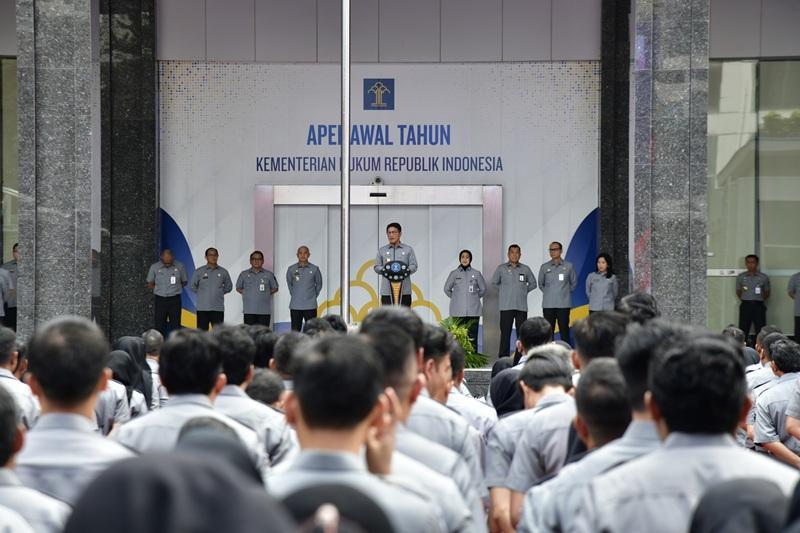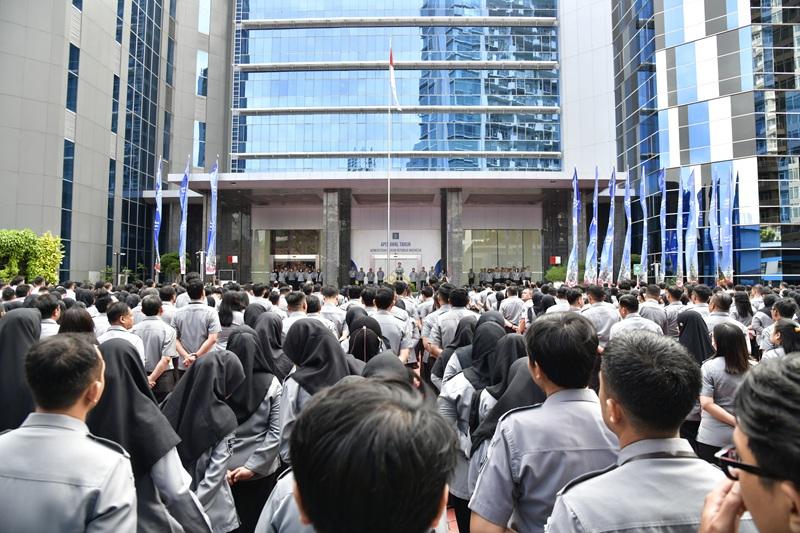
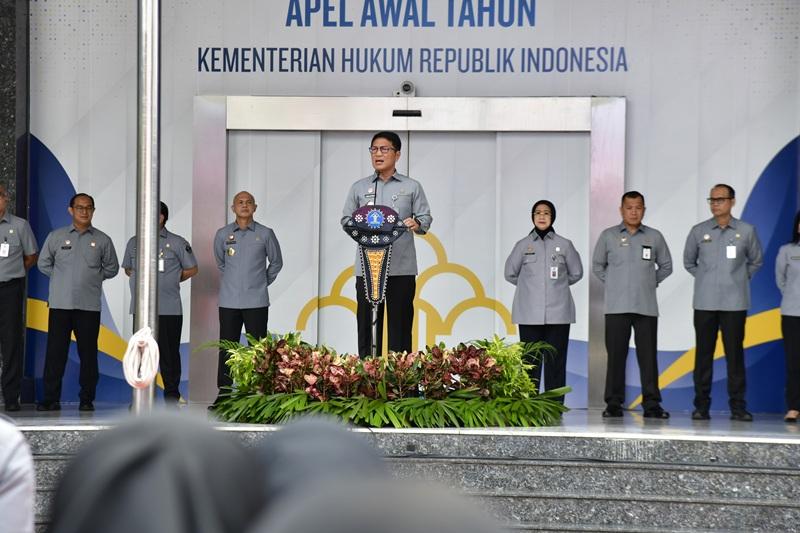
Jakarta – The Ministry of Law (Kemenkum) concluded 2025 amid significant challenges as well as notable achievements. Throughout the year, the Ministry faced rigorous tests in the form of shifting policy dynamics, increasing performance demands, and evolving public expectations.
Amid these conditions, collaboration and the collective hard work of all staff became the cornerstone of institutional resilience. Secretary General of the Ministry of Law, Nico Afinta, expressed his appreciation and gratitude to all staff for their dedication, loyalty, and commitment.
“These achievements are not the result of individual efforts, but the outcome of collaboration and a strong spirit of togetherness. This is something we should all be grateful for and proud of,” Nico said in his remarks at the 2026 New Year Assembly held at the Ministry of Law’s ceremonial grounds on Monday (5 January 2026).
However, he emphasized that these accomplishments should not be celebrated excessively. Instead, 2026 is viewed as a new starting point to move further forward with higher targets. The Ministry is expected to become more adaptive to change, more professional in its work, and more consistent in delivering high-quality, results-oriented public services.
“The Ministry of Law serves as a key pillar in realizing the President’s Asta Cita in law enforcement and legal development in Indonesia. This must serve as our reference in improving performance and delivering legal services to the public,” Nico stated.
As part of its strategic steps toward 2026, the Ministry also reaffirmed its commitment to enhancing public understanding and awareness of national legal reforms. One such effort will be the organization of press conferences addressing the implementation of the Criminal Code (KUHP), the Criminal Procedure Code (KUHAP), and the Law on Criminal Adjustment, all of which officially came into force on 2 January 2026.
“We will hold a press conference to address misinformation regarding the enactment of the new Criminal Code. This is part of our responsibility to clearly communicate policies to the public,” he explained.
In closing, Nico called on all Ministry staff to work wholeheartedly, not merely to fulfill administrative obligations, but to contribute meaningful solutions that generate tangible impact for both the organization and society.
“Major change does not always stem from perfect steps, but from the courage to begin and the consistency to carry it through,” he concluded.