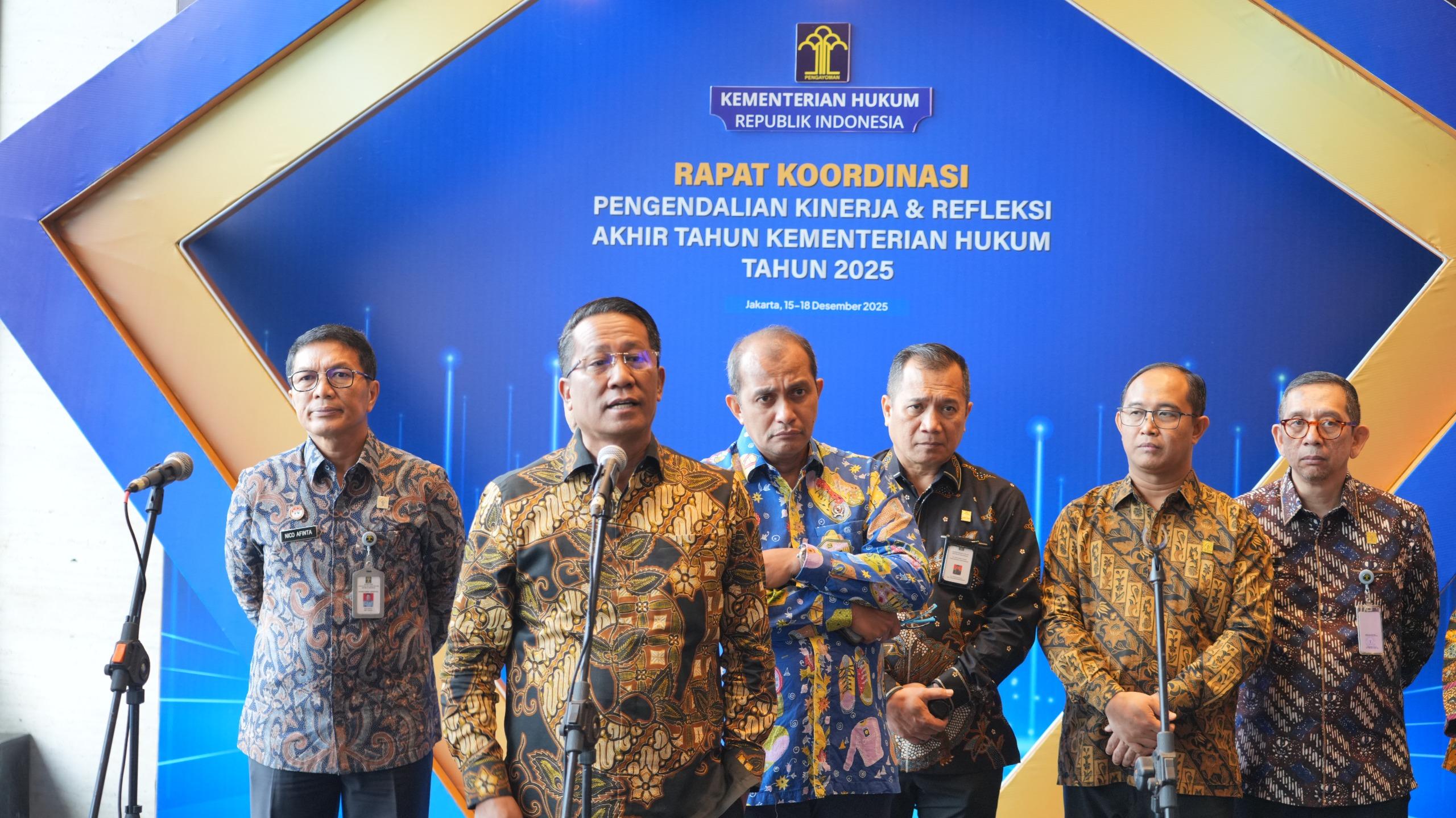
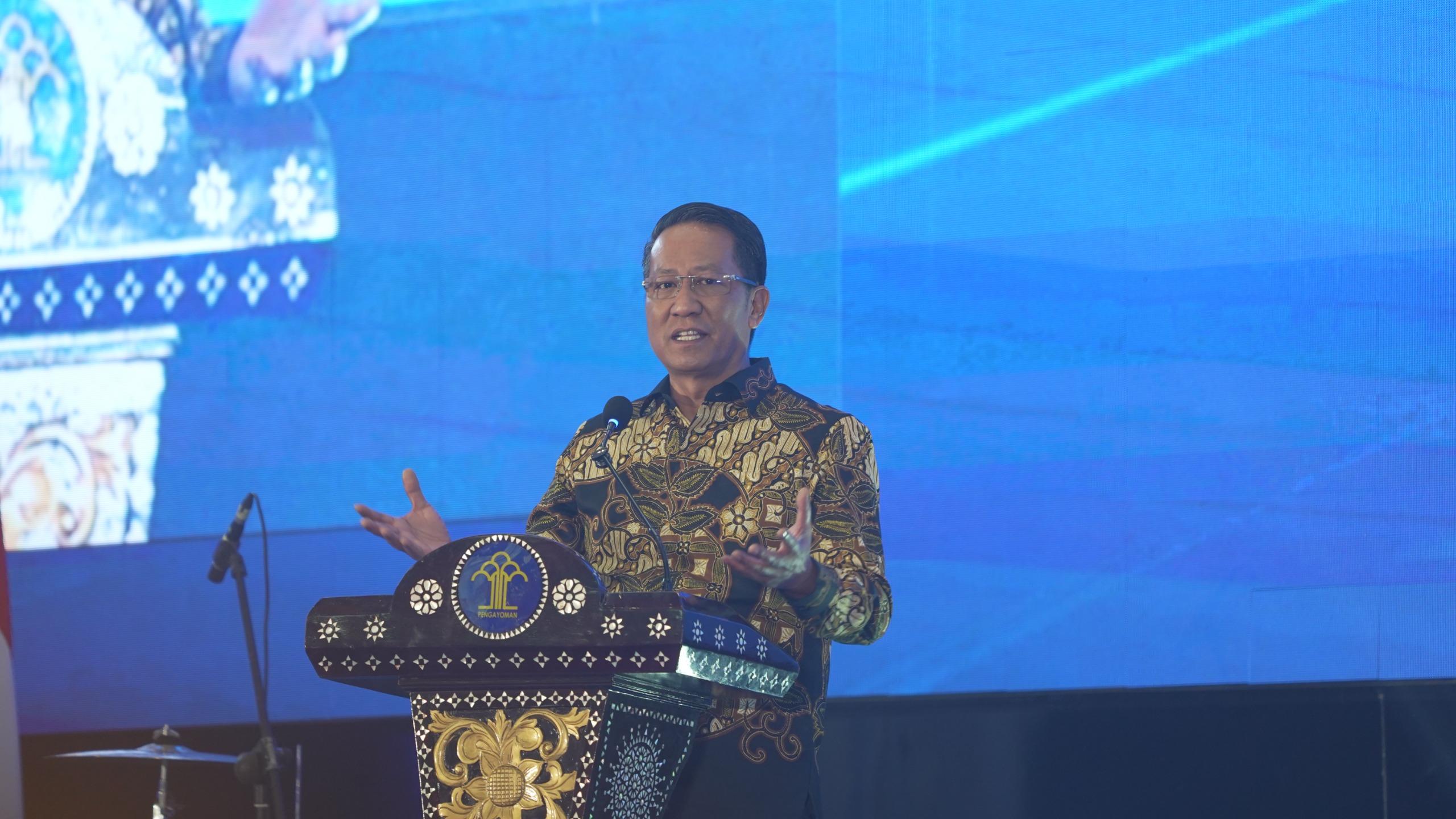
Jakarta – The Ministry of Law recorded significant achievements in delivering legal services to the public throughout the 2025 fiscal year. Minister of Law Supratman Andi Agtas noted measurable improvements across multiple service areas, with several indicators exceeding annual targets. The following outlines the Ministry of Law’s achievements as of December 2025.
In the area of Legal Administrative Affairs (AHU), the Ministry of Law processed 12,283,097 applications out of a total 12,346,995 submissions, achieving a completion rate of 99.48 percent. AHU services generated non-tax state revenue (PNBP) amounting to IDR 1.123 trillion, surpassing the 2025 target of IDR 1.09 trillion and reflecting a 2.58 percent increase compared to the same period in 2024.
“All AHU services are now fully digital, making them more accessible, transparent, and faster for the public,” Supratman said at the Grand Mercure Kemayoran on Thursday (December 18, 2025).
During the year, the Ministry of Law also successfully supported the registration of the Merah Putih Village and Urban Cooperative program, one of President Prabowo’s initiatives, with 83,020 cooperatives officially legalized.
In the field of Intellectual Property (IP), the Ministry of Law completed 385,675 IP applications, exceeding the total number of applications (372,760). This represents a 15.12 percent increase compared to 2024, when 330,521 applications were completed during the same period.
The higher completion rate reflects improvements in substantive examination processes, including the resolution of trademark and simple patent applications submitted in the latter quarters of the previous year. IP-related PNBP also increased by 4.16 percent, rising from IDR 857.7 billion in 2024 to IDR 893.35 billion in 2025.
“We are working to build an intellectual property–based economic growth model through education, easier registration, and stronger enforcement,” Supratman said.
He also highlighted Indonesia’s ongoing efforts to reform the global music royalty system through an international proposal on digital royalty management. The initiative has been presented at multiple international forums, including the 47th Standing Committee on Copyright and Related Rights (SCCR) meeting in Switzerland, and has received broad international support.
The proposal focuses on three pillars: global royalty governance within the WIPO framework, user-based royalty distribution systems, and strengthened cross-border collective management organizations.
To further promote IP as a driver of regional economic growth, the Ministry of Law intensified the registration of Geographical Indications (GI). Indonesia now ranks first in Southeast Asia with 261 registered GI products, accounting for 27.6 percent of all GI registrations in ASEAN.
“Beyond protection, we aim to ensure that registered GI products deliver real economic benefits to communities across Indonesia,” Supratman added.
In the legislative sector, the Ministry of Law continued to support regulatory reform through priority bills and government regulations. In 2025, the Ministry drafted four priority bills, covering civil procedure law, narcotics and psychotropic substances, bankruptcy law reform, and movable asset security.
“The Criminal Procedure Code Bill was passed into law by the DPR on 18 November 2025. It is a cornerstone of our national legal system and was drafted through an inclusive and participatory process,” Supratman said.
The Ministry of Law completed the harmonization of 15,104 legislative drafts out of 15,994 submissions, achieving a 94.44 percent completion rate through its electronic harmonization system. The Ministry also promulgated 1,042 regulations in the BNRI, 44 in the LNRI, and 32 Constitutional Court decisions, while translating 46 central and 56 regional regulations.
As the national legal aid administrator, the Ministry of Law provided 7,597 litigation legal aid services and 2,064 non-litigation services through 777 accredited legal aid organizations.
To expand access to justice at the grassroots level, Ministry of Law initiated the establishment of Village and Urban Village Legal Aid Posts (Posbankum). As of 2025, 71,868 Posbankum have been established, covering 85.61 percent of Indonesia’s 83,946 villages and urban villages far exceeding the annual target of 7,000.
“Regional heads have shown strong enthusiasm. We expect legal issues at the village level to be resolved outside court, with Posbankum providing free access to justice nationwide,” Supratman said, noting that 30 of Indonesia’s 38 provinces have achieved full Posbankum coverage.
The Ministry of Law also completed regulatory reviews of 121 central-level laws and 256 regional regulations to assess effectiveness and alignment.
In human resource development, the Ministry of Law conducted extensive competency development programs through various training methods, including webinars, classroom training, MOOCs, distance learning, and hybrid formats. A total of 62,317 participants attended training programs in 2025, while 2,038 civil servants underwent competency assessments at the Human Resources Development Agency.
The Ministry also received approval to open new applied law programs at the Indonesian Correctional Polytechnic, covering Legal Administrative Affairs, Legal Development, Intellectual Property Law, and Legislative Drafting.
Throughout 2025, the Ministry of Law produced 85 policy analysis reports, with 98.91 percent of recommendations followed up, including a national priority study on the urgency of developing Limited Liability Partnership (LLP) business entities in Indonesia.
In administrative governance, the Ministry of Law achieved a BerAKHLAK Index score of 91.92 (Grade A) and improved its Bureaucratic Reform Index from 83.63 in 2023 to 90.38 in 2024. The Inspectorate General followed up on 234 internal audit findings valued at IDR 1.11 billion and resolved 91.39 percent of audit recommendations from the State Audit Board (BPK).
Supratman emphasized that these achievements were driven by continuous digitalization and innovation across all levels of the Ministry of Law. The Ministry is currently implementing a comprehensive digital transformation of public legal services and preparing to launch a Super App to streamline access.
“The Super App will simplify legal services, enhance transparency and certainty, support digital transformation, and eliminate application duplication across units,” he concluded.