
Jakarta – After a long and historic process marked by cross-generational debate, Indonesia has officially entered a new chapter in law enforcement. With the enactment of the Criminal Code (KUHP) and the Criminal Procedure Code (KUHAP), the country reaffirms its commitment to building a legal system that is more modern and aligned with national values.
Vice Minister of Law Edward Omar Sharif Hiariej stated that the adoption of the KUHP represents the culmination of a decades-long effort. Drafting began in 1963 and took 59 years to complete, culminating in its passage on 2 January 2023 and full implementation on 2 January 2026.
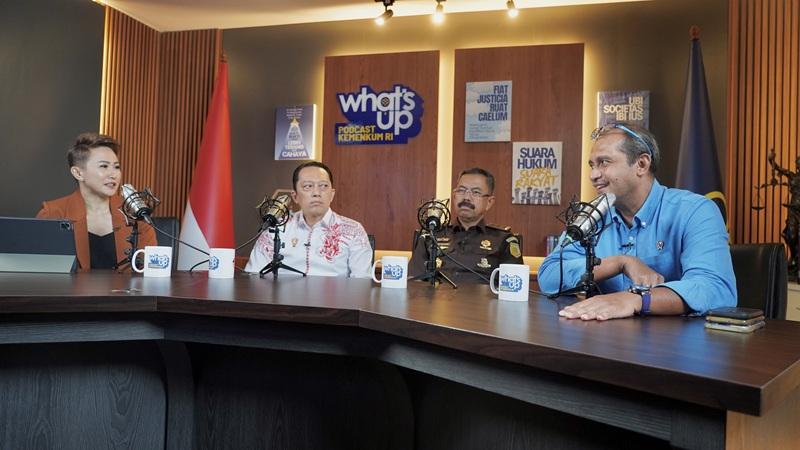
“After nearly 80 years of independence, Indonesia finally has its own Criminal Code. This was inevitable,” said Hiariej, who is widely known as Eddy, during an episode of the What’s Up Kemenkum RI podcast on Thursday (22 January 2026).
The introduction of the KUHP has also had significant implications for other legal frameworks. As substantive law, the KUHP must be complemented by the KUHAP which serves as the governing procedural law.
“Once we have substantive criminal law, we must also have procedural law. Our current Criminal Procedure Code (KUHAP) is over 45 years old, from 1981 to 2026. Naturally, it could no longer accommodate the developments introduced by the new KUHP,” Eddy explained.
“As a result, many advances in criminal law reflected in the KUHP made it necessary to revise the KUHAP accordingly,” he added.
Article 613 of the KUHP mandates that within three years of its promulgation, legislation must be enacted to align criminal provisions in regional regulations and laws outside the KUHP. This led to the issuance of Law Number 1 of 2026 on Criminal Sanction Adjustment.
“This law provides guidance for both regional regulations and criminal provisions outside the KUHP,” Eddy noted.
Meanwhile, Asep Nana Mulyana, Vice Attorney General for General Crimes, highlighted a key difference between the former KUHAP (Law No. 8 of 1981) and the new KUHAP (Law No. 20 of 2025): the regulation of coordination mechanisms among criminal justice officials.
“As Prof. Eddy puts it, prosecutors and investigators are like two sides of the same coin, different, yet inseparable. This means prosecutors are involved from the outset, ensuring that evidence collection complies with proper procedures. In practice, this approach is not entirely new for us,” Asep explained.
In the same discussion, Brigadier General Iksantyo Bagus Pramono, Head of the Legal Drafting Bureau of the National Police Legal Division, said the new KUHP and KUHAP have significantly improved coordination between investigators and prosecutors.
“Under the old KUHAP, coordination between investigators and public prosecutors was not clearly regulated. The new KUHAP minimizes differences in interpretation and addresses long-standing issues such as repeated case file revisions and procedural delays,” he said.
The What’s Up Kemenkum RI podcast episode titled “59 Years in the Making: What’s New in Indonesia’s Criminal Code?” features Vice Minister Edward Omar Sharif Hiariej, Vice Attorney General Asep Nana Mulyana, and Brig. Gen. Iksantyo Bagus Pramono. The episode explores the fundamental reforms introduced by the new KUHP and their impact on law enforcement in Indonesia, and premiered on the Ministry of Law’s official YouTube channel on Friday, 23 January 2026.