
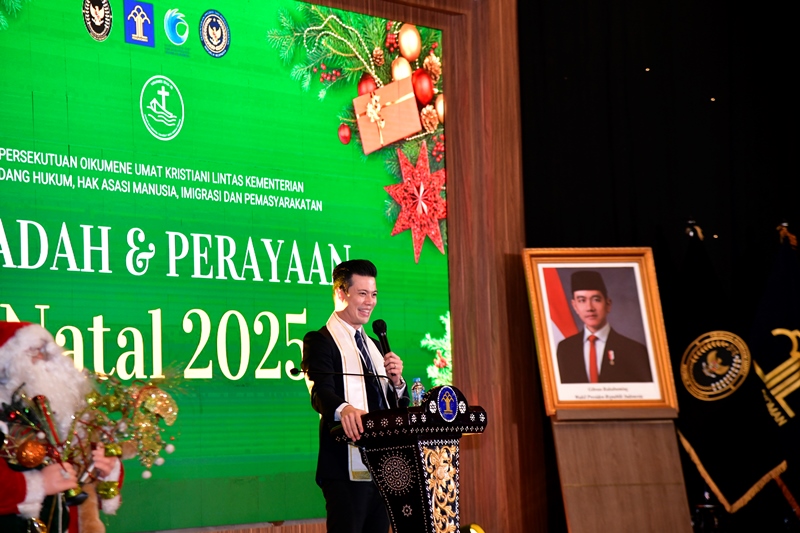
Jakarta – The family was reaffirmed as a vital foundation of communal life during the Christmas Worship and Celebration of the Inter-Ministerial Ecumenical Fellowship in the fields of Law, Human Rights, Immigration, and Corrections, held at the Ministry of Law on Thursday (22 January 2026).
Carrying the theme “God Is Present to Save Families,” the celebration offered both spiritual reflection and a message of national unity. In his sermon, Rev. Marcel Saerang emphasized the family as the starting point of life’s journey and success.
“Everything begins with the family. Many people achieve remarkable success because they have a strong support system, their family,” Marcel said.
He noted that families in Indonesia continue to face serious challenges, reflected in the rising divorce rates in recent years. For this reason, he stressed, families must be built on a strong foundation.
Drawing from Mark 10:6–9, Marcel outlined four core principles of a Christian family: placing God first, embracing differences, fostering independence, and maintaining lifelong faithfulness.
“God is the initiator who forms the family. Therefore, when we begin a family, God must come first. Christian families are not without problems, which is why God must be the foundation. No matter the storms, a household built on Him will remain strong and blessed,” he said.
Meanwhile, Fr. Thomas Ulun Ismoyo, Pr., invited participants to view family life with honesty and humanity. He acknowledged the complexity and dynamics of family relationships, while underscoring the family as the first place where people learn about love.
“The family is the first church. It is where we learn love, acceptance, forgiveness, how to manage conflict, and how to walk together amid imperfection,” Thomas said.
He emphasized that no family is perfect, yet it is within imperfection that God’s presence is experienced.
“There is no perfect father, no perfect mother. It is in that imperfection that we encounter the perfect God,” he added.
Thomas expressed hope that the joy of Christmas would be truly lived out within families, encouraging them to seek God’s grace so that the household becomes the primary place of character formation.
“May families become places where reverence for God, honesty, hard work, perseverance, solidarity, and cooperation are nurtured to help build a better world,” he said.
From a national perspective, Vice Coordinating Minister for Law, Human Rights, Immigration, and Corrections, Otto Hasibuan, highlighted the strategic role of families, not only for individuals, but also in the workplace and society.
“Family is indeed essential. When we can bring happiness to our families, we carry that sense of well-being into our workplaces. In turn, this helps create harmony within society,” Otto said.
He also pointed to the diversity within government institutions, which are comprised by civil servants from various ethnic and cultural backgrounds. Despite these differences, he noted, they are united by a shared purpose: serving the nation and the state.
“If we hold the same principle, that we are here to serve the nation, there should be no divisions among us,” he said.
“No nation can prosper if its families are fractured and unhappy. That is why we must begin at the smallest unit: the family,” Otto added.
The Christmas celebration served as a moment of collective reflection for civil servants across ministries. With families strengthened and blessed, the values of love, honesty, faithfulness, responsibility, and dedication are expected to be more fully embodied in public service to society and the nation.