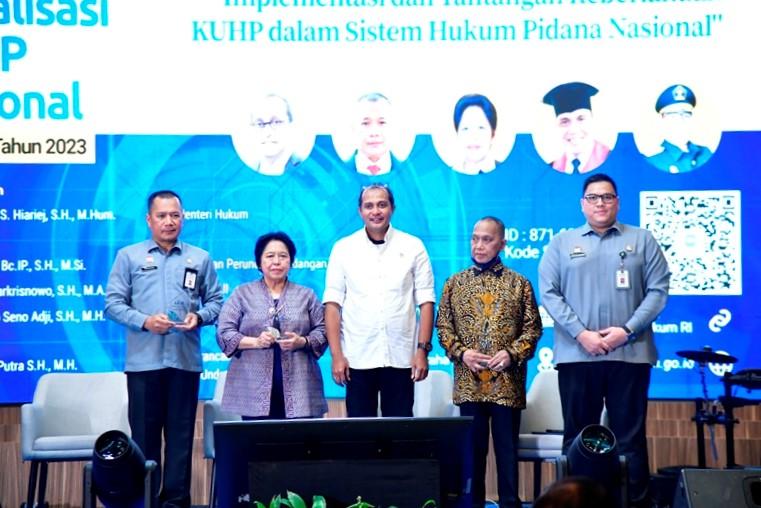
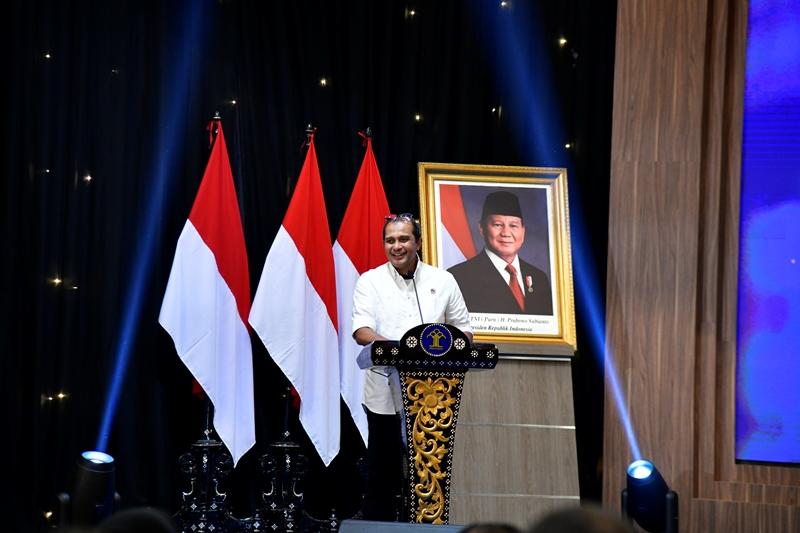
Jakarta – Deputy Minister of Law Eddy O. S. Hiariej stated that Indonesia’s criminal justice officials are fully prepared to implement the new Criminal Code (KUHP) and Criminal Procedure Code (KUHAP). However, he emphasized that the main challenge lies in public readiness and understanding of the fundamental shift in criminal law philosophy.
“I am confident that our police officers, prosecutors, and judges are ready to implement the new KUHP and KUHAP. My concern is whether the public is equally prepared, because this new Criminal Code changes our shared legal paradigm,” Eddy said during the National Criminal Code Socialization event at Graha Pengayoman, Jakarta, on Monday (26 Januari 2026).
He noted that many people still view criminal law primarily as a tool for retribution. When a crime occurs, public reaction often demands that the offender be immediately arrested, prosecuted, and punished as harshly as possible.
“This shows that our mindset still treats criminal law as a means of revenge. In fact, the new KUHP reflects a modern criminal justice paradigm focused on corrective, restorative, and rehabilitative justice,” he explained.
Eddy stressed that the restorative justice mechanisms now regulated under the KUHP and KUHAP must be properly understood by the public. Without sufficient awareness, he warned, their implementation could trigger public suspicion toward criminal justice officials.
“There must be no perception that police officers, prosecutors, or judges have been bribed, when in fact these mechanisms are explicitly provided for under the KUHP and KUHAP,” he said.
He also highlighted several concrete examples demonstrating institutional readiness, including changes in the Corruption Eradication Commission’s press conference practices to avoid the presumption of guilt, prosecutions based on the new Criminal Code, and court rulings applying judicial pardon and community service sanctions.
“Recently in Kudus, a local legislator was convicted of gambling. The prosecutor sought a six-month sentence, which the judge approved but substituted with four months of community service, two hours per day at the village office,” Eddy explained.
“These examples show that our criminal justice officials are ready to implement the new KUHP and KUHAP. Our shared task now is to clearly explain to the public the vision, mission, and paradigm underlying the National Criminal Code,” he added.
Regarding the substance of the KUHP and KUHAP, Eddy acknowledged that the new laws are not perfect. Nevertheless, he emphasized that they represent the best possible outcome of a rigorous drafting process involving 15 legal experts and extensive deliberation.
“We fully recognize that the new KUHP and KUHAP are not sacred texts. But they are the best contribution we could offer to the nation. Any controversy surrounding certain provisions is natural in a country as multiethnic, multireligious, and multicultural as Indonesia,” Eddy concluded.